Distributed vs. Centralized Intelligence in IoT
Where should your system’s “brain” reside? A practical guide to smart nodes, dumb nodes, and the trade-offs that matter.
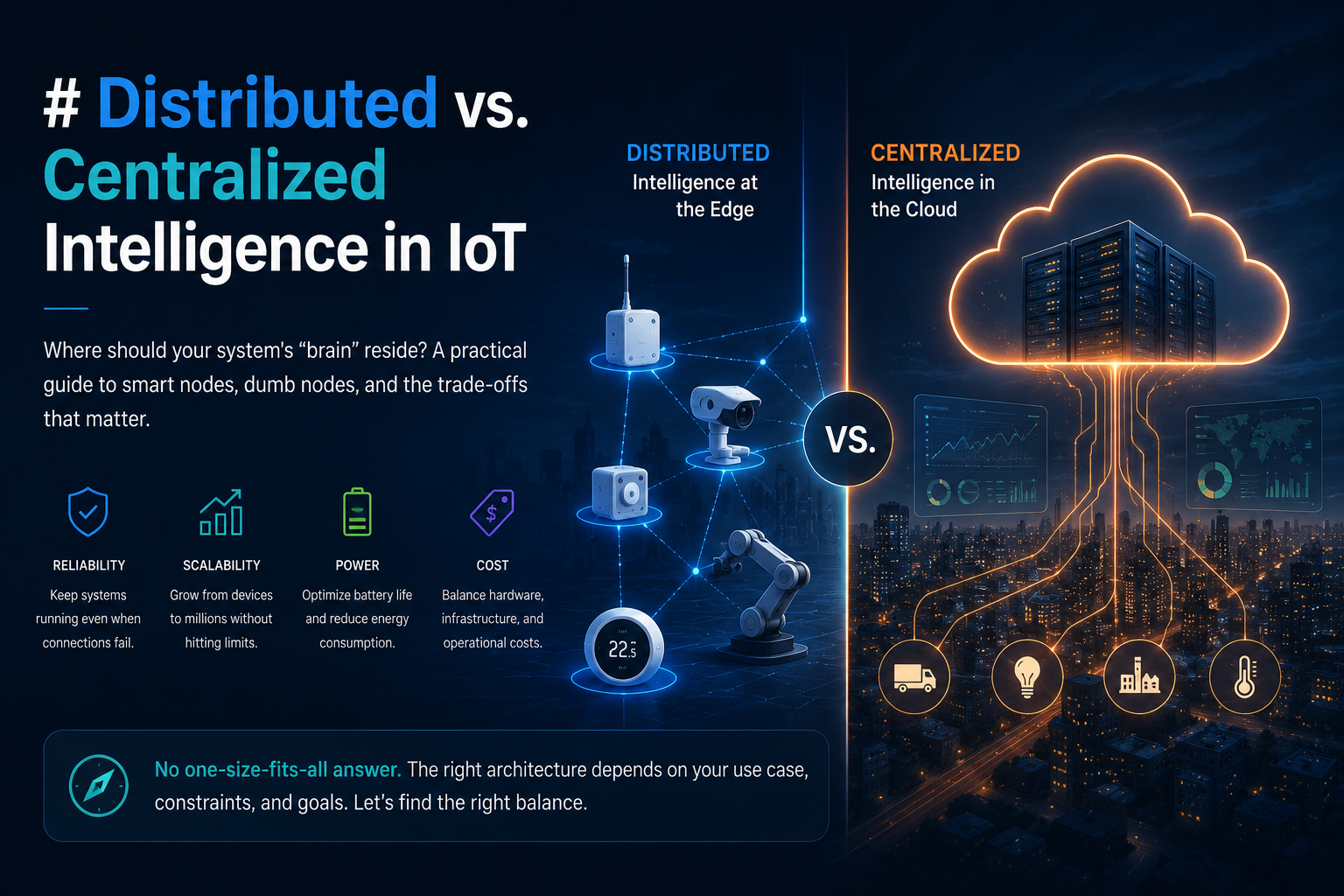
Distributed vs. Centralized Intelligence in IoT
Introduction
One of the most consequential architectural decisions in IoT system design is where to place intelligence. Should each device be smart enough to make its own decisions? Or should devices be simple and rely on a powerful central server to orchestrate everything?
This is not a trivial choice. It affects reliability, scalability, power consumption, cost, and even your business model. In this article, we examine both approaches in depth and provide a framework to help you choose the right balance for your specific use case.
1. Smart Nodes + Simple Server (Distributed Intelligence)
Definition
In this model, each node (sensor or actuator) has significant processing power and runs its own logic locally. Nodes make independent decisions based on sensor data, pre-defined rules, or even embedded AI models. The central server primarily serves as a data aggregator and reporting layer, not as the decision-maker.
Best For
- Weak or intermittent internet connections – nodes can operate without a network link.
- Unstable power supplies – nodes can store and forward data when power is restored.
- Remote or off-grid locations – where a reliable connection to a central server is impractical.
- Time-critical responses – actions that must happen immediately (e.g., emergency shutdown).
Advantages
- Autonomous Operation – nodes continue functioning even when the network is down.
- Local Data Processing – reduces bandwidth usage and central server load.
- Store-and-Forward Capability – nodes queue data locally and transmit when connectivity resumes.
- Low Latency – decisions happen at the edge, eliminating round-trip delays.
- Reduced Server Dependency – lower operational costs for server infrastructure.
Disadvantages
- Complex Firmware – each node must implement sophisticated logic.
- Orchestration Challenges – coordinating hundreds of independent nodes can lead to “chaos” (conflicting decisions, unsynchronized behaviour).
- Difficult Updates – distributing and managing firmware updates across many diverse nodes is labor-intensive.
- Higher Node Cost – more powerful microcontrollers and more memory increase hardware costs.
- Limited Global Optimization – nodes lack the “big picture” view that a central server has.
Example Scenario
A fleet of agricultural sensors deployed in a remote field. Each sensor monitors soil moisture and operates a local irrigation valve. It decides autonomously when to irrigate based on its own readings and stored thresholds. If the LoRa network goes down, the system continues to function perfectly—the server is only needed for reporting and trend analysis.
2. Dumb Nodes + Smart Server (Centralized Orchestration)
Definition
In this model, nodes are simple endpoints. They collect data and send it to the server, or they receive commands and actuate accordingly. All decision-making logic—thresholds, rules, scheduling, and AI—resides on a powerful central server or cloud platform.
Best For
- Stable network conditions – reliable connectivity to the server.
- Continuous power supply – nodes are mains-powered or have ample batteries.
- Large-scale deployments – hundreds or thousands of nodes need coordinated behaviour.
- Complex decision-making – scenarios requiring AI or cross-device correlation.
Advantages
- Simple, Low-Cost Nodes – use cheaper, less powerful microcontrollers.
- Easy Scalability – add or remove nodes with simple server configuration changes.
- Centralized AI Analysis – powerful models running on the server can process data from all nodes and detect complex patterns.
- Consistent System Behaviour – all nodes follow the same logical rules and can be updated simultaneously.
- Simplified Firmware – devices only need to read sensors, report data, and execute commands.
- Easy Auditing and Logging – all decisions are recorded centrally.
Disadvantages
- Single Point of Failure – if the server or network fails, the entire system stops.
- Network Dependency – nodes must have connectivity to function.
- Latency – actions require a full round-trip to the server and back.
- Higher Bandwidth Requirements – all data must be transmitted, increasing network load.
- Security Risk – a breach at the server level compromises the entire fleet.
Example Scenario
A smart office building with 200 occupancy sensors, light controllers, and HVAC actuators. The server aggregates occupancy data from all floors, balances heating/cooling loads, and ensures lights are only on in occupied zones. The system’s intelligence is centralized because the decisions require a holistic view of the entire building. If a node fails, it simply doesn’t report—the server continues to orchestrate the rest.
3. Comparison Table
| Aspect | Smart Nodes + Simple Server | Dumb Nodes + Smart Server |
|---|---|---|
| Node Complexity | High | Low |
| Node Cost | Higher | Lower |
| Network Dependency | Low – functions offline | High – needs connectivity |
| Latency | Very low (local decision) | Higher (round-trip) |
| Scalability | Challenging | Easy |
| Global Optimisation | Poor – nodes act locally | Excellent – full system view |
| Firmware Updates | Complex, per-node | Simple, centralised |
| Security Risk | Distributed | Centralised (bigger target) |
| Best For | Remote, unstable environments | Stable, large-scale environments |
4. Hybrid Approach: The Best of Both Worlds
In practice, the choice is rarely black-and-white. Many modern IoT systems use a hybrid architecture that combines the strengths of both models.
Common Hybrid Patterns
1. Edge AI with Central Coordination
- Nodes run lightweight AI models for immediate, critical decisions (e.g., emergency shutoff).
- The central server handles strategic decisions, long-term analytics, and updates.
- Example: A security system where cameras trigger local alerts immediately, but the server performs forensic analysis and pattern recognition.
2. Hierarchical Architecture
- Local gateways act as “middle-tier” intelligence for clusters of dumb nodes.
- Gateways perform local aggregation and decision-making, then relay summaries to the central server.
- Example: Industrial IoT where a facility gateway processes data from 50 sensors, and the central cloud handles cross-facility analytics.
3. Adaptive Intelligence
- Nodes are smart enough to operate autonomously when connectivity is lost.
- When the network is restored, they synchronize with the server and adopt its instructions.
- Example: Marine monitoring buoys that store data and follow local rules at sea, but sync with the server when they return to port.
N3xar’s Hybrid Implementation
The N3xar platform explicitly supports both modes:
- Low-power autonomous nodes – for long-term sensor use in remote locations.
- Powered nodes – for sensors and actuators in infrastructure-rich environments.
- Central server – orchestrates, aggregates, and provides AI analytics.
Clients choose the deployment model that fits their needs—from fully autonomous edge devices to centrally orchestrated smart cities.
“Our system supports both wired and wireless communication and uses two node types: low-power autonomous nodes for long-term sensor use, and powered nodes for sensors and actuators. Nodes integrate seamlessly into existing systems.” – N3xar Platform Overview
5. Decision Framework: Which Should You Choose?
Choose Smart Nodes + Simple Server If:
- Your deployment is in a remote or unstable environment.
- Network connectivity is not guaranteed.
- Immediate, low-latency responses are critical.
- You want to reduce bandwidth usage and server load.
- Your nodes need to operate for long periods independently.
Choose Dumb Nodes + Smart Server If:
- You have reliable, high-bandwidth connectivity.
- Nodes are mains-powered or have ample power.
- You are deploying at large scale and need central control.
- Complex analytics and cross-device coordination are required.
- You want to minimize node cost and complexity.
Consider a Hybrid Approach If:
- Your deployment has mixed requirements (some remote, some connected).
- You need edge-level responsiveness with cloud-level coordination.
- You are building a platform that must serve diverse client needs.
- You want flexibility to evolve your architecture over time.
6. Real-World Implementation: N3xar
To illustrate these concepts in practice, here is how the N3xar platform handles intelligence distribution:
- Device Types: Simple controllers, sensor modules, video cameras, DVRs, security systems, computers, and industrial machinery.
- Protocol Support: Both wired (twisted pair, PowerLine, coaxial, 2-wire) and wireless (LoRaWAN, GSM, 2G–5G).
- Node Modes: Autonomous (smart) and controlled (dumb) modes are both supported.
- Measurement Capabilities: Environmental (temperature, humidity, pressure, light, dust, noise, motion, gyroscopes) and digital (dry contacts, actuator statuses, software sensors).
- Server Role: Central orchestration, AI analytics, multi-channel alerts, historical logging, and API access.
This flexible architecture allows N3xar to serve projects ranging from small remote monitoring stations to large industrial facilities, all with a single codebase and deployment model.
7. Conclusion
The choice between distributed and centralized intelligence is not about which is “better”—it’s about which is more appropriate for your specific context.
- Smart nodes excel where independence, low latency, and offline capability are paramount.
- Dumb nodes shine where scale, central control, and cost-efficiency are priorities.
- Hybrid architectures offer the most flexibility, allowing you to tailor intelligence placement to each component of your system.
As an integrator, understanding these trade-offs is essential. It allows you to design systems that are not only technically sound but also aligned with your client’s operational reality and business goals. The best solutions often combine elements of both—smart enough to survive network outages, but centralised enough to make intelligent global decisions.
Further Reading
- Designing Scalable IoT Systems: A Practical Guide for Integrators – the main article providing a broad overview of IoT architecture.
- Choosing Between Open and Closed IoT Architectures – understanding the hardware and software ecosystem.
- Building Predictive Maintenance Systems – how AI and centralised intelligence enable proactive monitoring.
This article is based on practical experience building the N3xar platform, where hybrid intelligence models are deployed daily to solve real-world IoT challenges.