Choosing Between Open and Closed IoT Architectures
A deep dive into the trade‑offs, business implications, and real‑world decision frameworks.
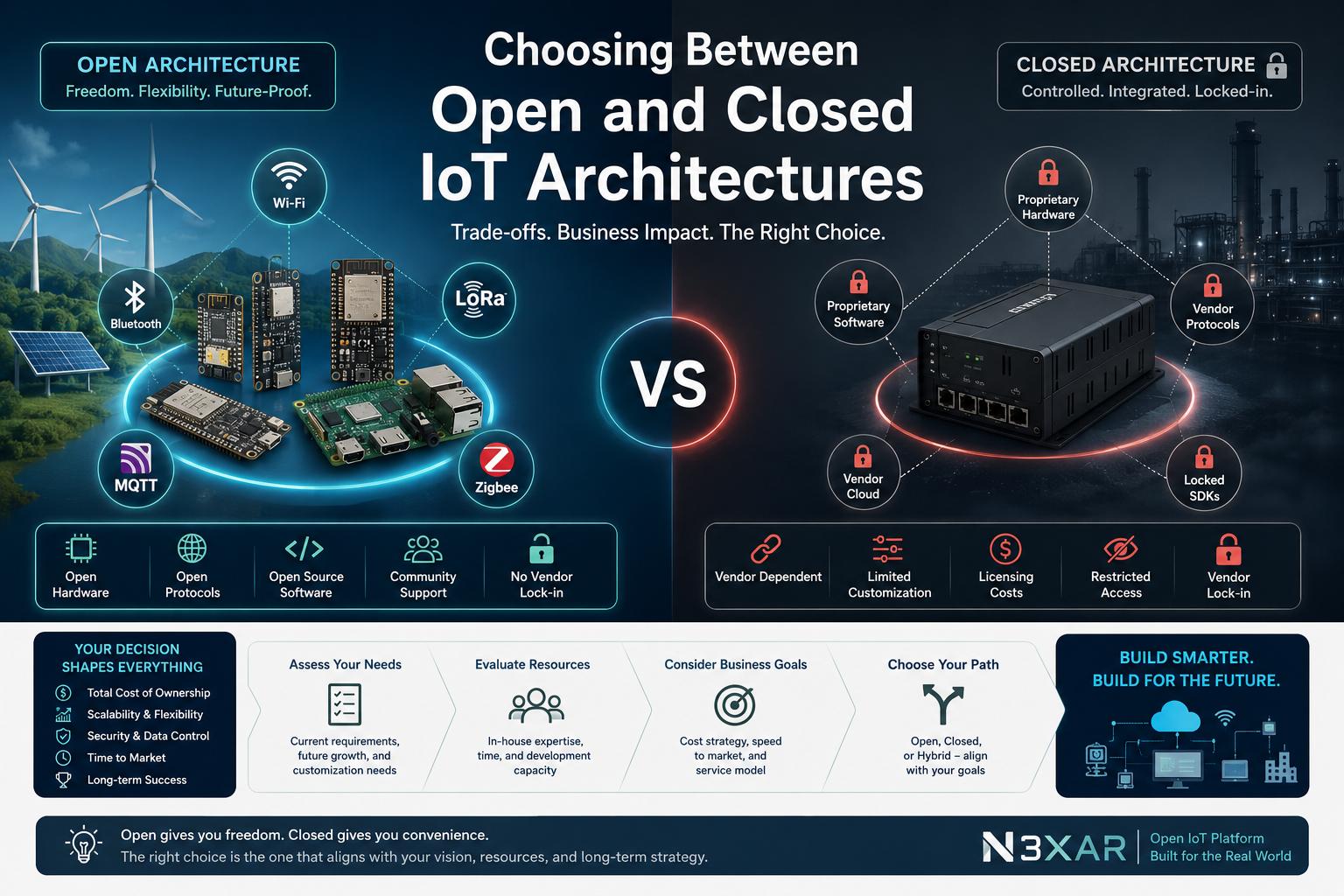
Open and Closed IoT Architectures
Introduction
One of the first and most consequential decisions you will make when building an IoT system is whether to adopt an open, commodity‑based architecture or a closed, proprietary solution. This choice affects not only your technical stack but also your business model, long‑term costs, and ability to adapt to changing requirements.
In this article, we explore what each approach entails, examine their strengths and weaknesses, and provide a practical decision framework to guide your choice.
What Is an Open IoT Architecture?
An open architecture relies on widely available, non‑proprietary components:
- Microcontrollers – ESP32, STM32, RP2040, Raspberry Pi
- Communication – Wi‑Fi, LoRa, Bluetooth, Zigbee (open standards)
- Software – open‑source stacks (MQTT, Node.js, Python, Docker, PostgreSQL)
- Development – Arduino IDE, PlatformIO, ESP‑IDF, Zephyr
Key characteristics:
- Components can be sourced from multiple vendors.
- Firmware and software can be modified and extended.
- Community support and extensive documentation are available.
- No single vendor controls the entire stack.
Real‑world examples:
- N3xar – built entirely on open hardware and software.
- Home Assistant – open‑source home automation platform.
- The Things Network – community‑driven LoRaWAN infrastructure.
What Is a Closed IoT Architecture?
A closed (proprietary) architecture offers a tightly integrated hardware‑software stack from a single vendor:
- Microcontrollers – custom‑designed or locked to a specific manufacturer (e.g., Siemens, Honeywell, Schneider Electric).
- Communication – often uses proprietary protocols or heavily modified versions of open standards.
- Software – vendor‑supplied SDKs, configuration tools, and cloud platforms.
- Development – typically uses vendor‑specific IDEs, languages, and APIs.
Key characteristics:
- Limited or no access to internal firmware.
- System configuration is often “no‑code” or low‑code.
- Updates and security patches are managed by the vendor.
- You are locked into that vendor’s ecosystem.
Real‑world examples:
- Siemens SIMATIC – industrial automation.
- Honeywell Tridium – building management.
- Schneider Electric EcoStruxure – energy management.
Advantages and Disadvantages at a Glance
| Aspect | Open Architecture | Closed Architecture |
|---|---|---|
| Flexibility | Extremely high – you can customise everything. | Low – limited to vendor‑exposed features. |
| Cost | Low component cost; no licence fees. | High hardware cost; often recurring licensing. |
| Vendor Lock‑in | None – you can switch suppliers anytime. | Severe – migration is difficult and costly. |
| Community Support | Large, active communities and extensive online resources. | Limited to vendor forums and paid support. |
| Security | You are responsible; but you can audit and patch yourself. | Vendor‑managed, but you depend on their responsiveness. |
| Time‑to‑Market | Longer, as you must integrate and test all components yourself. | Shorter – out‑of‑the‑box solutions are ready to deploy. |
| Scalability | Highly scalable with standard infrastructure. | Scalable, but often requires vendor‑specific scaling mechanisms. |
| Maintenance | You must manage updates, firmware, and compatibility. | Vendor manages updates, reducing your burden. |
The Business Opportunity: Open Architecture as a Service
One of the most compelling advantages of open architectures is the ability to build your own IoT platform as a service.
- Build your backend using open‑source tools (Node.js, Python, InfluxDB, Grafana).
- Containerise it with Docker for easy deployment.
- Offer it to clients as a hosted SaaS or as a self‑managed on‑premise solution.
This model allows you to:
- Charge for the software and services, not the hardware.
- Give clients full control over their data (they can run the platform on their own servers).
- Scale from a single client to thousands without dependency on a third‑party cloud provider.
Example: The N3xar platform is built on open architecture and provides both a hosted version and a Docker‑based self‑deployment option. This flexibility is a major selling point for enterprise clients with strict data‑sovereignty requirements.
Decision Framework: Which One Should You Choose?
Choose Open Architecture If:
- You have (or can hire) the technical expertise to integrate and maintain the system.
- You expect requirements to evolve and need the ability to customise.
- Long‑term cost control is important (no recurring licence fees).
- You want to avoid vendor lock‑in.
- Data sovereignty is critical – your clients may want to host the platform themselves.
- You plan to build a service‑based business around the platform.
Choose Closed Architecture If:
- You need a rapid, low‑effort deployment with minimal technical overhead.
- You don’t have in‑house IoT expertise.
- The vendor’s feature set already meets all your current and future needs.
- You prefer to outsource security and maintenance.
- The initial cost is less important than speed to market.
Real‑World Scenarios
| Scenario | Recommended |
|---|---|
| A startup building a unique smart‑building solution with custom sensors and analytics. | Open – you need full control. |
| A small business wanting to monitor a single warehouse with off‑the‑shelf sensors and simple alerts. | Closed – quicker and easier. |
| A government agency requiring absolute data privacy and ability to audit every line of code. | Open – you must be able to review and modify. |
| A large factory upgrading to Industry 4.0, with strict compliance requirements and a large budget. | Closed – proven industrial solutions may be preferred. |
Hybrid Approaches: The Best of Both Worlds?
It is not always black‑and‑white. Many systems use a mix:
- Open core with proprietary add‑ons – for example, using an open MQTT broker but a closed‑source analytics module.
- Closed hardware with open software – some vendors provide an open SDK to allow custom applications.
- Open for development, closed for production – you might prototype on open hardware, but deploy with a certified closed system for reliability.
N3xar’s approach: We use open hardware for nodes (ESP32, STM32) and a fully open‑source software stack, but we offer proprietary value‑added services like AI analytics and advanced alerting as paid features. This gives clients the freedom of open source with optional premium capabilities.
Conclusion: Aligning Architecture with Business Goals
Choosing between open and closed IoT architectures is not merely a technical decision – it is a strategic one that will shape your product, business model, and long‑term flexibility.
Open architectures give you freedom, customisation, and a path to building a service‑based business. They require technical maturity and a willingness to manage the full stack.
Closed architectures offer convenience, speed, and reduced technical burden. They are ideal when you need to deploy quickly and can accept the constraints of a vendor‑defined ecosystem.
As an integrator, my recommendation is to start with an open architecture if you have the skills. The flexibility it provides is invaluable for tailoring solutions to your clients’ specific needs, and it positions you as a true expert who can deliver end‑to‑end solutions – exactly what the market is looking for.
Further Reading
- Designing Scalable IoT Systems: A Practical Guide for Integrators – the main article providing a broad overview of IoT architecture.
- Distributed vs. Centralised Intelligence in IoT – choosing where to place logic.
- Dockerising Your IoT Stack – how to containerise your open‑source backend.
This article is part of a series on IoT system design, based on practical experience building the N3xar platform.