Building Predictive Maintenance Systems
How AI, IoT, and centralised intelligence enable proactive monitoring, reduce downtime, and transform industrial operations.
Introduction
Imagine knowing that a critical machine will fail in three days—not because it has already broken down, but because its vibration pattern, temperature, and current draw are telling you so. This is the promise of predictive maintenance (PdM) : moving from reactive “fix it when it breaks” to proactive “fix it before it breaks.”
Traditional maintenance falls into two camps: reactive (responding after failure, driving high costs and collateral damage) and preventive (scheduling service at fixed intervals, which can waste resources and still miss failures). Predictive maintenance offers a third path: just-in-time intervention, performed exactly when needed based on the actual condition of the equipment.
This article explores how AI, IoT sensors, and centralised intelligence work together to build predictive maintenance systems. We’ll cover the architecture, the AI models, the implementation roadmap, and the real-world benefits that make PdM one of the most transformative applications of industrial IoT.
1. What Is Predictive Maintenance?
1.1 From Reactive to Predictive
The evolution of maintenance strategies can be visualised as a progression:
Reactive (RM) → Preventive (PM) → Predictive (PdM) → Prescriptive
| Strategy | Approach | Result |
|---|---|---|
| Reactive | Fix after failure | High downtime, high costs, safety hazards |
| Preventive | Service at fixed intervals | May over-service, may miss early failures |
| Predictive | Service based on condition data | Just-in-time, optimal resource use |
| Prescriptive | AI recommends optimal actions | Fully autonomous maintenance |
1.2 The Three Pillars of Predictive Maintenance
Predictive maintenance rests on three core capabilities:
- Fault Detection – Identifying deviations from normal operating conditions
- Fault Diagnosis – Assessing the severity, impact, and root causes
- Fault Prognosis – Estimating time to failure or Remaining Useful Life (RUL)
“At least one of these objectives must be addressed as part of a predictive maintenance strategy, aimed at preventing failures and improving system efficiency.”
1.3 The Business Case
The numbers speak for themselves:
- 20-50% reduction in unplanned downtime
- 10-40% reduction in maintenance expenses
- 10-20% extension in equipment operational life
- 5-10% improvement in energy efficiency
- 5-30% energy savings in HVAC systems
For a manufacturing plant with 10,000 machines, these improvements translate into millions in annual savings.
2. How Predictive Maintenance Works
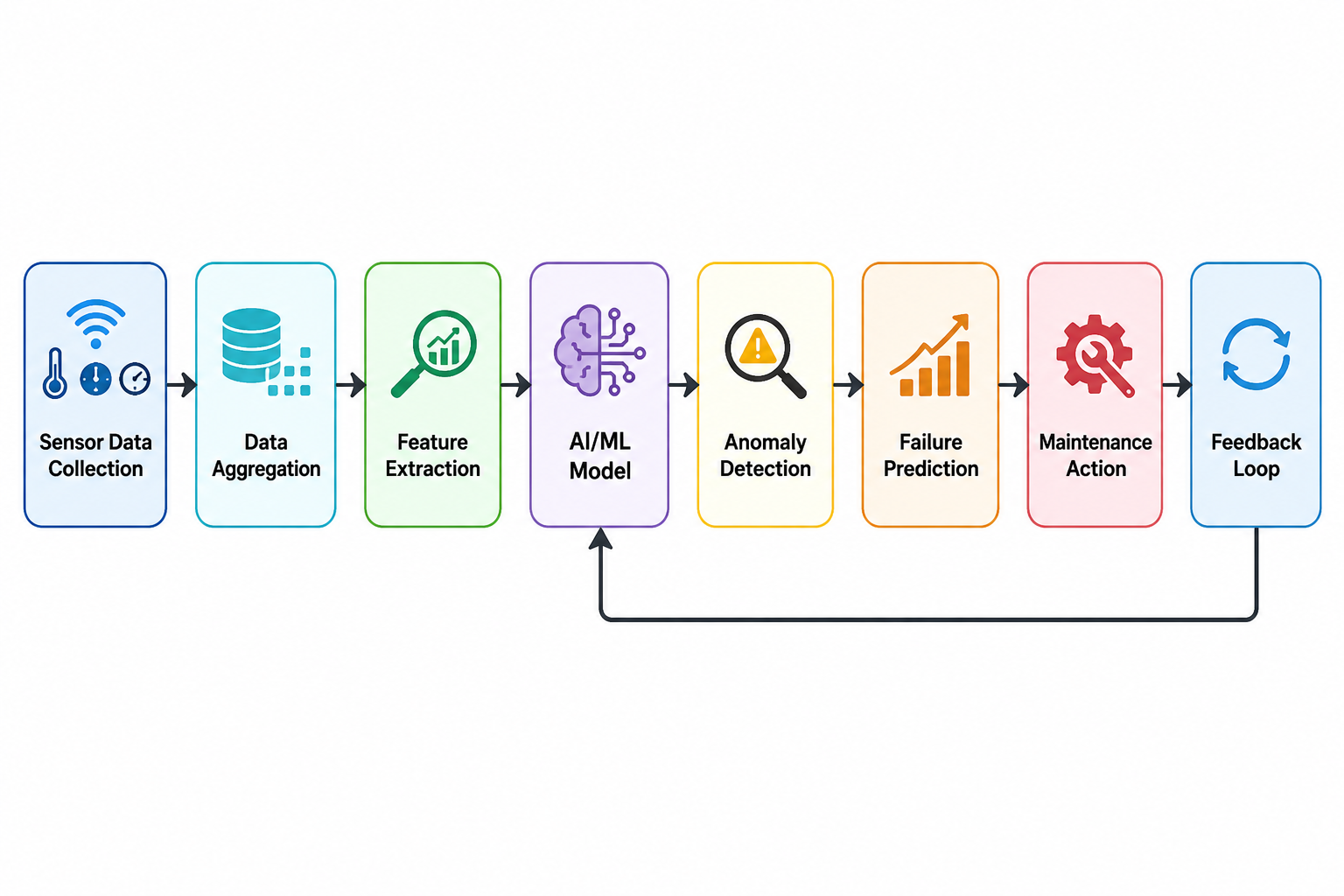
2.1 The Core Loop
2.2 What Gets Measured
Predictive maintenance systems monitor a variety of parameters, depending on the equipment:
| Parameter | What It Reveals | Typical Sensors |
|---|---|---|
| Vibration | Imbalance, misalignment, bearing wear | Accelerometers, IEPE sensors |
| Temperature | Overheating, friction, cooling failure | Thermocouples, IR sensors |
| Current/Power | Motor load, efficiency, electrical faults | Current transformers |
| Acoustic | Cavitation, leaks, mechanical looseness | Microphones, ultrasonic sensors |
| Pressure | Blockages, leaks, pump health | Pressure transducers |
| Oil Analysis | Wear particles, contamination | Optical/chemical sensors |
“AI predictive maintenance uses real-time multivariate sensor information to track operational states for continuous monitoring. The combination of vibration, acoustic, thermographic, and power consumption signals is entered into sophisticated machine learning systems, which detect irregularities and predict equipment breakdowns in advance.”
2.3 The Data Flow
A typical predictive maintenance system follows this pipeline:
┌─────────────────────────────────────────────────────────────────┐
│                   1. Data Collection                            │
│  Sensors on equipment → Edge Gateway → Cloud/On-Premise         │
└─────────────────────────────────────────────────────────────────┘
                              │
                              ▼
┌─────────────────────────────────────────────────────────────────┐
│                   2. Data Processing                            │
│  Cleaning → Normalisation → Feature Extraction → Aggregation    │
└─────────────────────────────────────────────────────────────────┘
                              │
                              ▼
┌─────────────────────────────────────────────────────────────────┐
│                   3. AI/ML Analysis                             │
│  Anomaly Detection → Pattern Recognition → RUL Prediction       │
└─────────────────────────────────────────────────────────────────┘
                              │
                              ▼
┌─────────────────────────────────────────────────────────────────┐
│                   4. Action                                     │
│  Alerts → Work Orders → Automated Shutdowns → Schedule Maint    │
└─────────────────────────────────────────────────────────────────┘
3. The Technology Stack
3.1 Reference Architecture
A comprehensive predictive maintenance system integrates multiple layers:
| Phase | Description | Components |
|---|---|---|
| Ingest & Process | Collect real-time data from devices | MQTT, Kafka, Edge gateways |
| Analyze & Transform | Detect anomalies in real-time | Stream processing, KQL |
| Train | Build and refine ML models | ML platforms, historical data |
| Visualize & Activate | Dashboards and notifications | Power BI, alerts, CMMS |
3.2 Key Technologies
IoT Sensors and Connectivity
- Vibration, temperature, current, acoustic sensors
- PLC and SCADA integration
- LoRaWAN, Wi-Fi, Ethernet, 5G connectivity
- Edge routers for secure data transmission
Edge Computing
- Local processing for low-latency detection
- Isolation forests, autoencoders, time-series forecasters
- Industrial PCs and gateway devices
AI and Machine Learning
- Supervised learning: Random Forests, SVMs, CNNs
- Time-series models: LSTM, GRU
- Anomaly detection: Isolation forests, autoencoders
- RUL prediction: Weibull distribution models
Cloud and Centralised Platforms
- Data aggregation from multiple sites
- Model training and versioning (MLOps)
- Integration with CMMS and ERP
3.3 Architecture Options
| Architecture | Description | Best For |
|---|---|---|
| Edge-Only | All processing at the edge | Real-time, low-latency, offline operation |
| Cloud-Only | All processing in the cloud | Complex models, large-scale data |
| Edge-Cloud Hybrid | Edge for real-time, cloud for training | Most industrial deployments |
“Edge-to-cloud architectures have emerged as the preferred solution for implementing predictive maintenance at scale, combining localized processing with centralized analytics.”
4. AI Models for Predictive Maintenance
4.1 Types of Models
| Model Type | Use Case | Example Algorithms |
|---|---|---|
| Classification | Is equipment healthy or faulty? | Random Forest, SVM |
| Regression | What is the RUL? | LSTM, GRU, Weibull |
| Anomaly Detection | Is this behaviour unusual? | Isolation Forest, Autoencoder |
| Time-Series Forecasting | What will the next value be? | LSTM, Prophet, ARIMA |
4.2 Data-Driven Approaches
Data-driven methods—based on machine learning and deep learning—have become the dominant approach for predictive maintenance because they:
- Require less domain expertise than physics-based or knowledge-based methods
- Capture rare or unforeseen operational patterns
- Adapt to diverse data and handle complex non-linear behaviour
- Detect unknown drifts in equipment performance
4.3 The RUL Problem
Remaining Useful Life (RUL) is the most valuable prediction a maintenance system can make. It answers the critical question: How much longer can this equipment operate safely?
RUL prediction typically uses:
- Historical failure data to train models
- Real-time sensor streams for current state
- Degradation models (physical or data-driven)
“Predictive systems utilize long short-term memory (LSTM) and gated recurrent unit (GRU) models, along with Weibull distribution models, to calculate remaining useful life (RUL), enabling organizations to perform maintenance at optimal times.”
4.4 A Practical Example: Rotating Machinery
For rotating machinery (motors, pumps, compressors), vibration analysis is the primary diagnostic tool:
- Data collection: Accelerometers measure vibration at multiple points
- FFT analysis: Fast Fourier Transform converts time-domain signals to frequency domain
- Feature extraction: Energy in specific frequency bands indicates specific faults
- Classification: ML model identifies fault type (imbalance, misalignment, bearing wear)
“The advancement of machine learning techniques has revolutionized the area of intelligent predictive maintenance, especially in industrial contexts, where fault classification on rotating machinery combines Fast Fourier Transform (FFT) and Principal Component Analysis (PCA) with supervised and unsupervised learning algorithms.”
5. Implementation Roadmap
5.1 Phase 1: Foundation
Goal: Establish data collection and visibility
Activities:
- Identify critical assets for monitoring
- Install appropriate sensors (vibration, temperature, current)
- Set up edge gateways for data collection
- Establish baseline data (normal operating conditions)
- Implement basic dashboards for visibility
Timeline: 1-3 months
5.2 Phase 2: Condition Monitoring
Goal: Detect anomalies and generate alerts
Activities:
- Implement rule-based alerts (thresholds, rate-of-change)
- Train initial anomaly detection models
- Deploy models at edge or in cloud
- Validate alerts with maintenance teams
- Refine thresholds and models
Timeline: 3-6 months
5.3 Phase 3: Predictive Analytics
Goal: Predict failures before they occur
Activities:
- Collect and label historical failure data
- Train RUL prediction models
- Integrate with CMMS/ERP for work orders
- Implement feedback loops for model improvement
- Develop predictive maintenance dashboards
Timeline: 6-12 months
5.4 Phase 4: Autonomous Maintenance
Goal: Automated decision-making and action
Activities:
- Implement closed-loop automation
- Enable automated shutdowns for critical failures
- Integrate with inventory systems (parts availability)
- Optimise maintenance schedules across entire fleet
- Continuous model retraining and improvement
Timeline: 12-18 months
5.5 Critical Success Factors
| Factor | Why It Matters |
|---|---|
| Data quality | Garbage in, garbage out |
| Domain expertise | Maintenance engineers know what signals matter |
| Executive buy-in | PdM requires investment and cultural change |
| Integration | Must work with existing systems (SCADA, CMMS, ERP) |
| Scalability | Start small, expand gradually |
6. Real-World Use Cases
6.1 Industrial Machinery
Scenario: A factory with 500 motors, pumps, and compressors
Implementation:
- Vibration and temperature sensors on each machine
- Edge gateways for real-time anomaly detection
- Cloud platform for model training and fleet-wide analytics
- Integration with CMMS for automated work orders
Results:
- 20-50% reduction in unplanned downtime
- 10-40% reduction in maintenance costs
- 10-20% longer equipment life
6.2 Smart Buildings (HVAC)
Scenario: A commercial building with 20 AHUs, 5 chillers, and 50 VAV boxes
Implementation:
- Temperature, pressure, and current sensors on HVAC equipment
- AI models for anomaly detection and RUL prediction
- Integration with BMS (Building Management System)
Results:
- 5-30% energy savings
- Reduced comfort complaints
- Extended equipment life
“HVAC systems account for up to 50% of building energy demand. Faults and suboptimal operation contribute to 15-30% of energy waste in commercial buildings.”
6.3 Vibratory Conveyors (Recycling Industry)
Scenario: SPALECK, a machine builder for vibratory conveyors and vibrating screens used in recycling, chemical, and food processing plants
Challenge:
- Local traffic-light indicators were overlooked
- Rigid thresholds failed as early-warning signals when products and operating modes changed
Solution:
- Machines connected via edge routers
- ML models for predictive maintenance as an integrated app
- In-platform labeling, model comparison, automated retraining
Results:
- Earlier fault detection (several days of lead time)
- Service-ready processes with clear alerts
- Fast rollout, secure remote access, scalable data pipeline
6.4 Telecommunications Infrastructure
Scenario: Field cabinets in Istanbul monitored for proactive maintenance
Implementation:
- IoT-based sensors with AI-powered analytics
Results:
- Early-stage anomaly detection
- Improved network reliability
- Reduced maintenance costs
“The study shows that the integration of IoT-based sensors with AI-powered analytics provides a scalable and energy-efficient solution for proactive monitoring of telecommunication infrastructures.”
7. N3xar’s Approach to Predictive Maintenance
The N3xar platform is designed to support predictive maintenance across diverse industries:
7.1 Data Collection Layer
- Environmental sensors: Temperature, humidity, pressure
- Motion sensors: Vibration, gyroscopes, speed
- Digital inputs: Equipment status, actuator states
- Software sensors: Performance metrics, logs
7.2 Aggregation and Analysis
- Real-time data streaming from multiple nodes
- Historical data storage for pattern recognition
- AI agents for anomaly detection and alerting
- Multi-channel alerts (Email, Telegram, WhatsApp, SMS)
7.3 AI Integration
- Edge AI for real-time detection
- Cloud AI for complex analysis and model training
- Hybrid architecture for optimal performance
“The platform supports real-time AI analytics, energy-efficient operations, and multi-channel alerts. Live state, events & log journal provide comprehensive visibility.”
7.4 Key Capabilities
| Capability | N3xar Implementation |
|---|---|
| Data Collection | IoT sensors, software sensors, digital inputs |
| Real-time Monitoring | Live dashboards, WebSocket updates |
| Anomaly Detection | AI agents with configurable thresholds |
| Alerting | Email, Telegram, WhatsApp, SMS |
| Historical Analysis | Time-series storage, trend analysis |
| Integration | APIs, MQTT, webhooks |
8. Challenges and Solutions
8.1 Data Quality
Challenge: Sensor data can be noisy, incomplete, or inconsistent
Solution:
- Data cleaning and validation pipelines
- Redundant sensors for critical parameters
- Automated outlier detection
8.2 Interoperability
Challenge: Equipment from multiple vendors using different protocols
Solution:
- Support for multiple industrial protocols (OPC UA, PROFINET, Modbus)
- Hardware-agnostic platform design
- Standardised data formats
8.3 Cybersecurity
Challenge: Connected equipment introduces security risks
Solution:
- Secure edge-to-cloud communication
- Device authentication and encryption
- Regular security audits
8.4 Lack of Historical Failure Data
Challenge: New equipment has no failure history
Solution:
- Start with condition monitoring (anomaly detection)
- Use transfer learning from similar equipment
- Collect data from day one
8.5 Cultural Resistance
Challenge: Maintenance teams may distrust AI predictions
Solution:
- Involve maintenance engineers from the start
- Provide explainable AI (why was this alert generated?)
- Start with simple alerts, build trust gradually
9. Future Trends
9.1 Digital Twins
Digital twins—virtual replicas of physical equipment—are becoming central to predictive maintenance:
- Link operational data to simulated physical behaviour
- Enable “what-if” testing without risk
- Improve anomaly detection by aligning simulated outcomes with real-time conditions
9.2 Generative AI
GenAI is enhancing traditional ML methods for maintenance:
- Natural language interfaces for maintenance teams
- Automated report generation
- Root cause analysis assistance
9.3 Federated Learning
Training models across multiple sites without centralising data:
- Privacy-preserving model improvement
- Learning from diverse equipment populations
- Reduced data transfer costs
9.4 Autonomous Maintenance
From prediction to action:
- Automated work order generation
- Self-healing systems
- Optimised maintenance scheduling across entire fleets
10. Conclusion
Predictive maintenance represents a fundamental shift in how we manage industrial equipment—from reacting to failures to anticipating them. The combination of IoT sensors, edge computing, and AI enables organisations to:
- Reduce downtime by 20-50%
- Cut maintenance costs by 10-40%
- Extend equipment life by 10-20%
- Improve energy efficiency by 5-10%
The journey from reactive to predictive is not trivial. It requires investment in sensors, connectivity, data infrastructure, and AI models. It demands cultural change and buy-in from maintenance teams. But the payoff—in reduced costs, improved reliability, and competitive advantage—is substantial.
“The best maintenance is the maintenance you never have to perform because you prevented the failure before it happened.”
With platforms like N3xar providing the foundational infrastructure—data collection, aggregation, AI analysis, and multi-channel alerts—organisations of all sizes can build predictive maintenance systems that were once the domain of only the largest enterprises.
Further Reading
- AI Agents for IoT: From Data to Action — how AI agents enable autonomous monitoring and alerting.
- IoT Network Design: From Nodes to Cloud — the infrastructure that makes predictive maintenance possible.
- Designing Scalable IoT Systems: A Practical Guide for Integrators – the main article providing a broad overview of IoT architecture.
This article is based on practical experience building the N3xar platform, which provides the infrastructure for predictive maintenance across industrial, building, and infrastructure applications.