AI Agents for IoT: From Data to Action
A comprehensive guide to integrating artificial intelligence into IoT systems, covering AI agents, data aggregation, and deployment architectures.
Introduction
The true power of IoT is not just in collecting data—it’s in turning that data into actionable intelligence. Artificial intelligence (AI) transforms IoT from a passive monitoring system into an active, decision-making platform capable of predicting failures, automating responses, and optimizing operations.
This article explores how AI integrates with IoT systems, covering AI agents for control and alerting, data aggregation for analysis, and the different deployment architectures (edge, cloud, and hybrid). Using real-world examples and N3xar’s implementation, we’ll show how AI can elevate your IoT solution from data collection to intelligent action.
1. AI Agents for Control and Alerting
1.1 What Are AI Agents?
AI agents are autonomous programs that continuously monitor data streams, analyze patterns, and make decisions or send alerts based on predefined rules and learned models. They act as the “brain” of your IoT system, translating complex data into clear, actionable signals.
1.2 The Signal Translation Model
One of the most powerful applications of AI in IoT is translating complex data into simple, intuitive signals:
| Signal | Meaning | Action Required |
|---|---|---|
| 🟢 Green | All systems normal | Continue monitoring |
| 🟡 Yellow | Pay attention, investigate | Check system, prepare for action |
| 🔴 Red | Act now, critical issue | Immediate intervention |
N3xar Implementation:
“Our AI-powered platform simplifies this by analyzing data in real time and translating it into clear signals: Green – All good, Yellow – Pay attention, Red – Act now.”
1.3 Example Use Cases
Use Case 1: Environmental Monitoring
Scenario: A smart building with temperature, humidity, and pressure sensors in critical areas (server rooms, laboratories, storage facilities).
AI Agent Function:
- Input: Temperature, humidity, pressure readings
- Analysis: Monitor trends, detect anomalies, predict when thresholds will be exceeded
- Actions:
- 🟢 Green: All parameters within normal range
- 🟡 Yellow: Temperature rising faster than normal; cooling system may need maintenance
- 🔴 Red: Temperature exceeds critical threshold; activate backup cooling, send emergency alert
Implementation Example:
# Pseudo-code for environmental monitoring AI agent
class EnvironmentalAgent:
    def analyze(self, temp, humidity, pressure):
        if temp > CRITICAL_TEMP:
            return {
                'signal': 'RED',
                'action': 'activate_backup_cooling',
                'message': f'Critical temperature: {temp}°C'
            }
        elif temp > WARNING_TEMP:
            return {
                'signal': 'YELLOW',
                'action': 'notify_maintenance',
                'message': f'Warning: Temperature rising ({temp}°C)'
            }
        else:
            return {'signal': 'GREEN', 'message': 'All systems normal'}
Use Case 2: Predictive Maintenance
Scenario: Industrial machinery (motors, pumps, compressors) monitored for vibration, temperature, and current draw.
AI Agent Function:
- Input: Vibration frequency, temperature, current draw
- Analysis: Detect patterns that precede failures (increasing vibration, temperature spikes, current fluctuations)
- Actions:
- 🟢 Green: Machine operating normally
- 🟡 Yellow: Vibration pattern indicates bearing wear; schedule maintenance in 2 weeks
- 🔴 Red: Critical vibration detected; shut down machine immediately
Implementation Example:
# Pseudo-code for predictive maintenance AI agent
class PredictiveMaintenanceAgent:
    def analyze(self, vibration, temperature, current):
        vibration_score = self.analyze_vibration(vibration)
        if vibration_score > CRITICAL_VIBRATION:
            return {
                'signal': 'RED',
                'action': 'emergency_shutdown',
                'message': 'Critical vibration detected - immediate shutdown required'
            }
        elif vibration_score > WARNING_VIBRATION:
            return {
                'signal': 'YELLOW',
                'action': 'schedule_maintenance',
                'message': 'Bearing wear detected - schedule maintenance within 2 weeks'
            }
        else:
            return {'signal': 'GREEN', 'message': 'Machine operating normally'}
Use Case 3: Security Systems
Scenario: A facility with motion sensors, cameras, and access control systems.
AI Agent Function:
- Input: Motion sensor data, camera feeds, access logs
- Analysis: Detect unauthorized access, identify unusual patterns, correlate events
- Actions:
- 🟢 Green: All secure, no anomalies
- 🟡 Yellow: Unusual activity detected (door opening after hours); investigate
- 🔴 Red: Unauthorized access confirmed; trigger lockdown, notify security
Implementation Example:
# Pseudo-code for security AI agent
class SecurityAgent:
    def analyze(self, motion, camera_feed, access_logs):
        if self.is_unauthorized_access(access_logs):
            return {
                'signal': 'RED',
                'action': 'trigger_lockdown',
                'message': 'Unauthorized access detected - lockdown initiated'
            }
        elif self.is_suspicious_activity(motion, access_logs):
            return {
                'signal': 'YELLOW',
                'action': 'alert_security',
                'message': 'Suspicious activity detected - security notified'
            }
        else:
            return {'signal': 'GREEN', 'message': 'All secure'}
2. Data Aggregation for AI Analysis
2.1 What Is Data Aggregation?
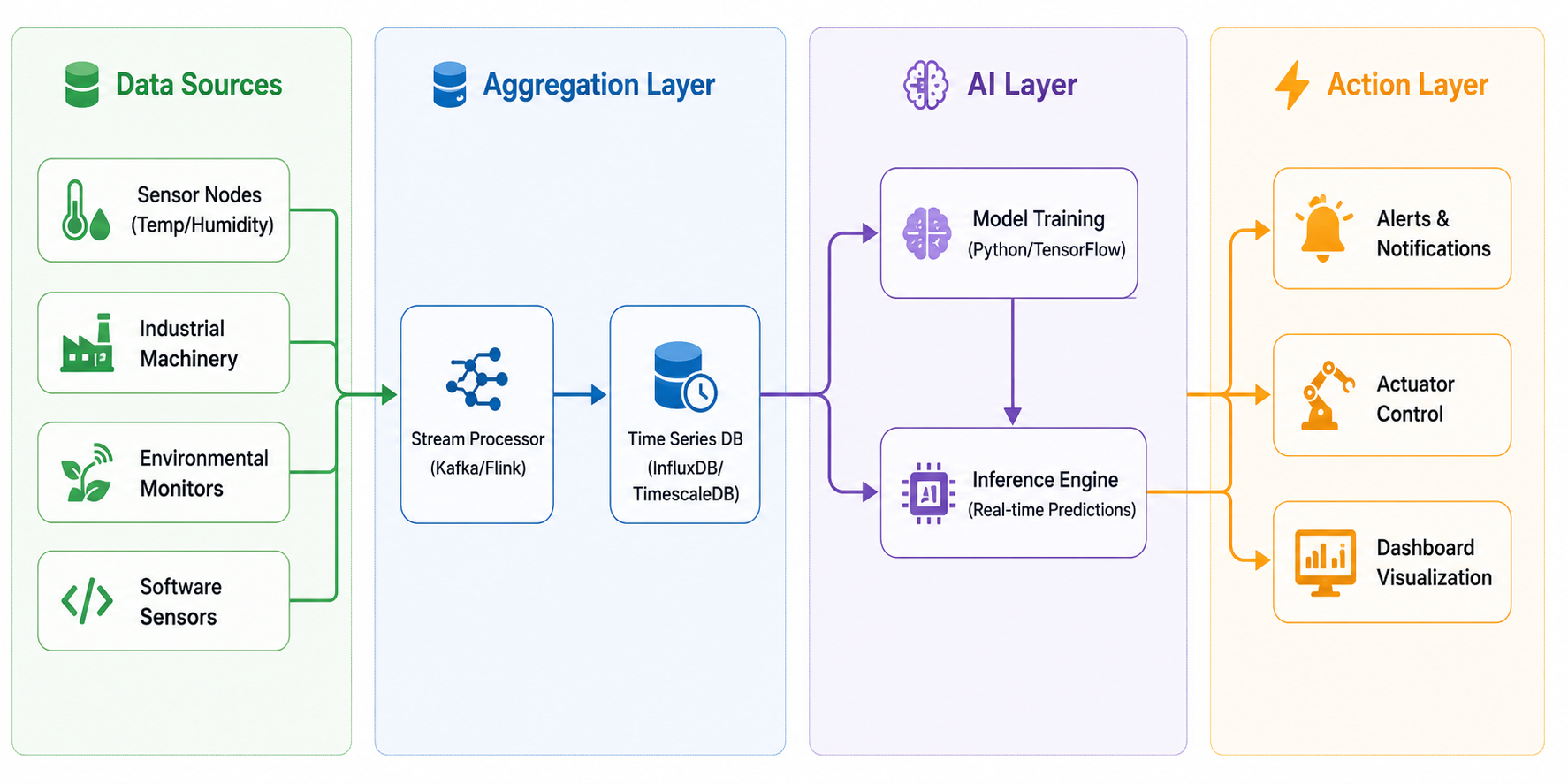
Data aggregation is the process of collecting, filtering, and combining data from multiple sources into formats that AI models can analyze. Aggregated data provides context, reveals patterns, and enables correlation across different systems.
2.2 Aggregation Architecture
2.3 Aggregation Capabilities
Precision Tracking of Values Over Time
Monitor individual data points and their evolution:
- Temperature trends: Upward/downward patterns
- Seasonal variations: Monthly or annual cycles
- Event triggers: What happened before a failure?
Example: Tracking a motor’s temperature over 6 months reveals a gradual increase that, combined with vibration data, indicates bearing wear.
Pattern Recognition Across Devices
Identify patterns that span multiple devices:
- Correlated events: When machine A heats up, machine B slows down
- Fleet-wide patterns: All devices in a specific location show similar behavior
- Anomaly detection: One device behaves differently from its peers
Example: All 20 HVAC units on the 3rd floor show higher than normal energy consumption—indicating a problem with the building’s insulation or a system-wide issue.
Correlation of Events Across Systems
Connect events from different systems:
- Security + Environmental: Unauthorized access coincides with temperature spike
- Production + Energy: Increased production leads to higher energy consumption
- Maintenance + Performance: Scheduled maintenance improves performance metrics
Example: A door sensor (security) detects an open door, and a temperature sensor (environmental) shows a rapid temperature change, indicating a door left open in a climate-controlled room.
Long-Term Trend Analysis
Analyze data over extended periods:
- Year-over-year comparisons: Seasonal patterns
- Predictive trends: When will a failure likely occur?
- Optimization insights: What improvements have worked?
Example: Two years of energy consumption data reveals that an HVAC system is 20% less efficient in summer, indicating it needs maintenance or upgrade.
2.4 Data Types for Aggregation (N3xar Example)
| Category | Examples | Purpose |
|---|---|---|
| Environmental | Temperature, humidity, pressure, light, dust, noise | Climate monitoring, comfort, safety |
| Motion | Gyroscopes, speed, acceleration | Movement tracking, vibration analysis |
| Digital | Dry contacts, actuator statuses | State monitoring, control verification |
| Software | CPU/memory usage, network connectivity, container diagnostics | IT infrastructure monitoring |
3. AI Integration: Architecture Models
3.1 Edge AI
Definition: AI models run directly on local gateways or edge devices, processing data where it’s generated.
Architecture Diagram:
Device → Edge Gateway (with AI model) → Action/Cloud
Advantages:
- Low latency: Decisions happen in milliseconds
- Works offline: No internet connection required
- Privacy: Data stays local, never leaves the edge
- Bandwidth savings: Only processed data (not raw data) is sent to cloud
Disadvantages:
- Limited compute power: Edge devices have limited CPU/RAM
- Storage constraints: Can’t store large datasets
- Model size: Must use lightweight models (e.g., TinyML)
- Update complexity: Updating edge models is harder than cloud models
Use Cases:
- Real-time alerts and control (emergency shutdowns)
- Privacy-sensitive applications (facial recognition)
- Remote locations with limited connectivity
- Simple pattern detection (vibration threshold)
Implementation Example:
# Edge AI using TensorFlow Lite Micro on ESP32
import tflite_micro

# Load quantized model (small footprint)
model = tflite_micro.Model.from_file('model.tflite')

# Run inference on edge device
def predict(vibration, temperature):
    input_data = [vibration, temperature]
    output = model.predict(input_data)
    return output[0]  # 0 = normal, 1 = warning, 2 = critical
3.2 Cloud AI
Definition: AI models run on cloud infrastructure with access to unlimited compute and storage.
Architecture Diagram:
Device → Cloud → AI Model → Action/Notification
Advantages:
- Unlimited compute: Train and run complex models
- Large datasets: Store and analyze years of data
- Model flexibility: Use any AI framework (TensorFlow, PyTorch)
- Easy updates: Models can be updated centrally
Disadvantages:
- Network dependency: Requires internet connectivity
- Higher latency: Round-trip to cloud adds delay
- Data transfer costs: Sending large datasets is expensive
- Privacy concerns: Data leaves the local environment
Use Cases:
- Complex analysis (image recognition, natural language)
- Training models (requires large datasets)
- Large-scale pattern recognition
- Business intelligence and reporting
Implementation Example:
# Cloud AI using AWS SageMaker
import boto3
import sagemaker

# Deploy trained model to endpoint
predictor = sagemaker.predictor.Predictor(
    endpoint_name='iot-predictive-maintenance',
    sagemaker_session=sagemaker.Session()
)

# Run inference
def predict(vibration, temperature, current):
    input_data = [[vibration, temperature, current]]
    result = predictor.predict(input_data)
    return result['prediction']
3.3 Hybrid AI
Definition: A combination of edge and cloud AI, where edge handles real-time decisions and cloud handles training and complex analysis.
Architecture Diagram:
Device → Edge Gateway → Real-time Action
         ↓
         Cloud → Complex Analysis → Training
Advantages:
- Best of both worlds: Low latency of edge, power of cloud
- Resilience: Edge continues when cloud is unavailable
- Efficiency: Edge filters data, cloud analyzes only what’s needed
- Continuous improvement: Edge models updated from cloud training
Disadvantages:
- More complex: Two systems to manage
- Model synchronization: Keeping edge and cloud models in sync
- Cost: Both edge hardware and cloud resources required
Implementation Example:
# Hybrid AI: Edge + Cloud
class HybridAI:
    def __init__(self):
        self.edge_model = self.load_edge_model()
        self.cloud_endpoint = self.get_cloud_endpoint()

    def predict(self, data):
        # First, edge inference for immediate action
        edge_result = self.edge_model.predict(data)

        if edge_result['confidence'] > 0.8:
            # High confidence: act immediately
            return edge_result['action']
        else:
            # Low confidence: send to cloud for confirmation
            cloud_result = self.cloud_endpoint.predict(data)
            return cloud_result['action']
3.4 Architecture Comparison
| Aspect | Edge AI | Cloud AI | Hybrid AI |
|---|---|---|---|
| Latency | Very low (<10ms) | High (100ms-1s) | Low for edge, high for cloud |
| Connectivity Required | No | Yes | No for edge, yes for cloud |
| Compute Power | Limited | Unlimited | Mixed |
| Privacy | High (data stays local) | Low (data leaves) | High for edge data |
| Model Size | Small (lightweight) | Large (complex) | Mixed |
| Update Complexity | High (per device) | Low (central) | Medium |
| Cost | Hardware cost | Usage cost | Both |
| Best For | Real-time actions | Complex analysis | Both combined |
4. Real-World Implementation: N3xar
4.1 AI-Powered Platform
The N3xar platform implements AI integration across all three architecture models, providing flexibility based on client requirements:
Edge AI Capabilities:
- Local alert generation on gateways
- Real-time threshold detection
- Simple pattern recognition
Cloud AI Capabilities:
- Complex data analysis and pattern recognition
- Anomaly detection across all devices
- Predictive maintenance modeling
- Training and retraining AI models
Hybrid Implementation:
- Edge handles immediate alerts and decisions
- Cloud provides training, complex analysis, and optimization
- Models are synchronized between edge and cloud
4.2 Data Aggregation Pipeline
N3xar’s data aggregation pipeline collects data from diverse sources:
- Ingestion: Data from sensors, software, and digital inputs flows into the platform
- Stream Processing: Real-time filtering, normalization, and aggregation
- Storage: Time-series and relational storage for historical analysis
- Analysis: AI agents process both real-time and historical data
- Action: Alerts, dashboards, and actuators respond to analysis results
4.3 N3xar’s AI Features
- Real-time AI analytics: Continuous analysis of data streams
- Energy-efficient operations: AI optimizes device power consumption
- Event detection: AI identifies anomalies and triggers appropriate responses
- Multi-channel alerts: Notifications via Email, Telegram, WhatsApp, SMS
- Live state, events & log journal: Comprehensive visibility into system behavior
“Real-time AI analytics, energy-efficient operations. Live state, events & log journal. Alerts via Email, Telegram, WhatsApp, SMS.”
5. Implementation Roadmap
Step 1: Define Your AI Use Cases
| Category | Questions to Answer |
|---|---|
| What are you monitoring? | Temperature? Vibration? Security? |
| What actions are needed? | Alerts? Automated responses? |
| How fast must you respond? | Milliseconds? Seconds? Minutes? |
| What is the data volume? | Bytes? Gigabytes? Terabytes? |
Step 2: Choose Your Architecture
| Architecture | When to Choose |
|---|---|
| Edge AI | Real-time response, limited connectivity, privacy-sensitive |
| Cloud AI | Complex models, large datasets, unlimited connectivity |
| Hybrid AI | Both real-time and complex analysis needed |
Step 3: Collect and Aggregate Data
- Identify data sources (sensors, software, digital inputs)
- Establish data collection (MQTT, HTTP, APIs)
- Implement aggregation (stream processing, time-series storage)
- Normalize data (consistent formats, units, timestamps)
Step 4: Train and Deploy Models
- Build your dataset (historical data for training)
- Select your algorithm (classification, regression, anomaly detection)
- Train your model (in cloud for complex models, optimized for edge)
- Validate and test (ensure model accuracy)
- Deploy (to edge, cloud, or both)
Step 5: Implement Actions
- Define actions (alerts, actuator commands, notifications)
- Integrate with systems (email, SMS, control systems)
- Create feedback loops (learn from outcomes)
- Monitor and optimize (continuous improvement)
6. Conclusion
AI integration transforms IoT from a data collection system into an intelligent decision-making platform. Key takeaways:
-
AI agents provide autonomous monitoring, decision-making, and alerting, translating complex data into simple signals (Green, Yellow, Red).
-
Data aggregation enables pattern recognition, correlation, and trend analysis across multiple devices and systems.
-
Edge AI offers low latency and offline capability for real-time actions, while Cloud AI provides unlimited compute and complex analysis.
-
Hybrid AI combines the best of both worlds—edge for immediate responses, cloud for training and complex analysis.
-
Implementation success requires careful use case definition, architecture selection, data aggregation, model training, and action integration.
“The best AI integration is not the one with the most advanced algorithms, but the one that most effectively turns data into action.”
The N3xar platform implements AI across edge, cloud, and hybrid architectures, providing clients with flexible, powerful, and actionable intelligence for their IoT deployments.
Further Reading
- Building Predictive Maintenance Systems – deep dive into AI for equipment monitoring.
- Designing Scalable IoT Systems: A Practical Guide for Integrators – the main article providing a broad overview of IoT architecture.
This article is based on practical experience building the N3xar platform, which integrates AI across edge, cloud, and hybrid architectures for intelligent IoT solutions.