AI Engineering & Automation
Bridging AI and industrial operations – intelligent automation with LangChain, n8n, and Python.
Overview
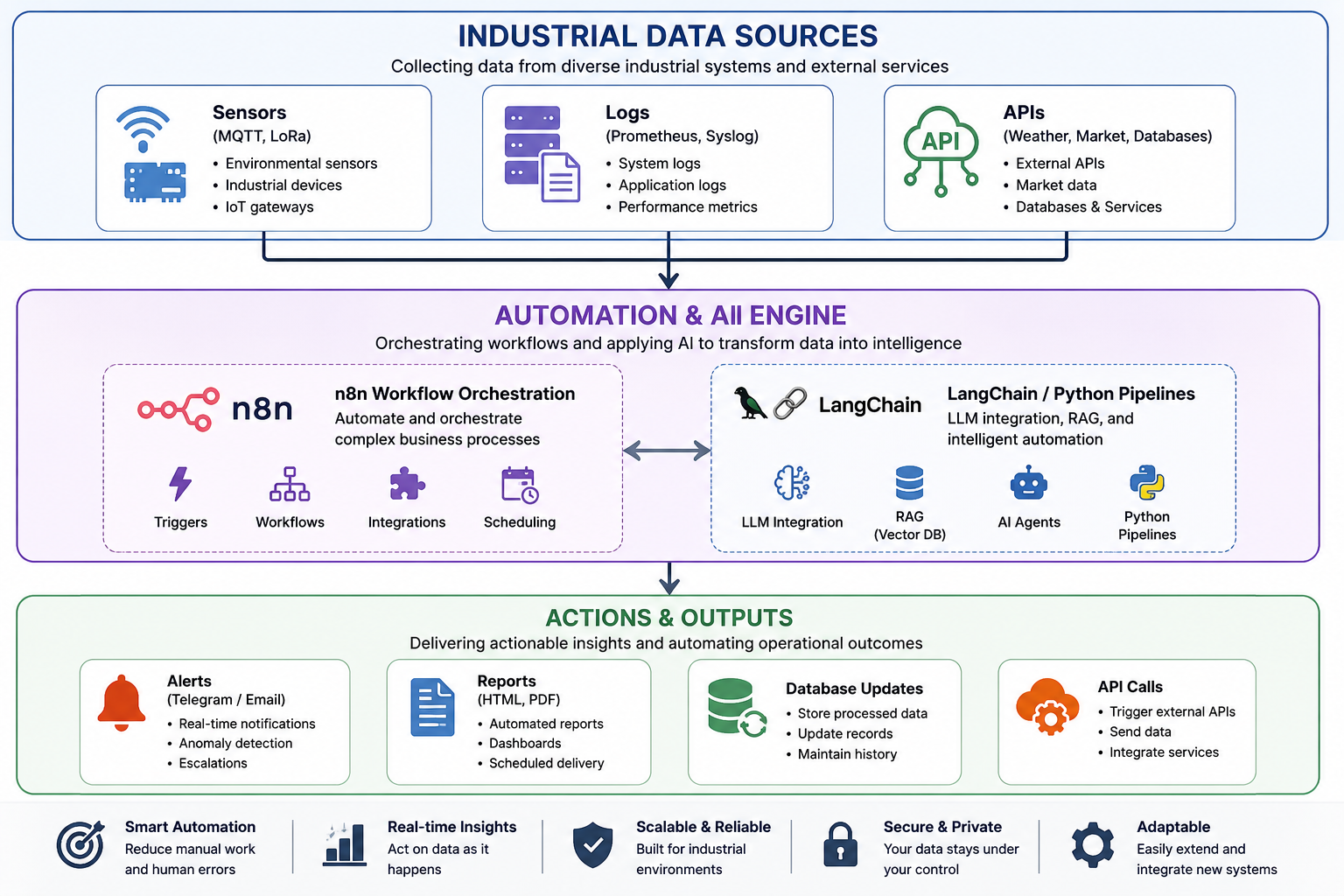
In industrial environments, data flows everywhere – from sensors, logs, APIs, and databases. The challenge isn’t collecting data; it’s acting on it intelligently.
My AI Engineering practice focuses on:
- Workflow automation – Orchestrating complex business logic with n8n.
- LLM integration – Using LangChain for document processing, retrieval-augmented generation (RAG), and intelligent agents.
- Custom automation – Python scripts for ETL pipelines, system administration, and IoT integration.
- Decision support – Feeding monitoring data into AI models for predictive insights.
The goal is simple: turn data into action, reduce manual effort, and enable smarter operations.
Architecture Overview
Core Capabilities
1. ⚙️ Workflow Orchestration with n8n
n8n is a powerful open-source workflow automation tool. I use it to connect disparate systems without writing custom glue code:
| Workflow Type | Description |
|---|---|
| Alert Aggregation | Collect alerts from Prometheus/Grafana, enrich with context, and route to Telegram, Email, or Slack. |
| Data Synchronisation | Sync data between databases, APIs, and file systems on a schedule. |
| IoT Event Processing | Listen to MQTT topics, process sensor data, and trigger actions. |
| Backup Automation | Trigger backup jobs, verify integrity, and notify on success/failure. |
| Report Generation | Query data from PostgreSQL, format as HTML/PDF, and email to stakeholders. |
Example n8n Workflow:
[Webhook Trigger] → [HTTP Request: Prometheus API] → [Filter Data] → [Telegram Send Message]2. 🧠 LLM Integration with LangChain
LangChain enables advanced AI capabilities for engineering and operational contexts:
| Capability | Description |
|---|---|
| Retrieval-Augmented Generation (RAG) | Query internal documentation (technical manuals, runbooks) using natural language. |
| Log Analysis | Analyze error logs and suggest remediation steps. |
| Incident Summaries | Automatically generate post-mortem summaries from monitoring data. |
| System Documentation | Generate documentation from infrastructure configuration. |
| Agentic Workflows | Multi-step AI agents that reason and take actions. |
Example LangChain Pipeline:
from langchain.embeddings import OpenAIEmbeddings
from langchain.vectorstores import Chroma
from langchain.chains import RetrievalQA

# Load engineering documentation
docs = load_documents("technical_manuals/")

# Create vector store
embeddings = OpenAIEmbeddings()
vectorstore = Chroma.from_documents(docs, embeddings)

# Query
qa_chain = RetrievalQA.from_chain_type(
    llm=ChatOpenAI(),
    retriever=vectorstore.as_retriever()
)

# Ask a question
result = qa_chain.run("How do I reset the LoRa gateway?")
print(result)  # "To reset the LoRa gateway, press the reset button for 10 seconds..."
3. 🐍 Custom Python Automation
Beyond off-the-shelf tools, I write custom automation scripts for specific engineering needs:
| Use Case | Description |
|---|---|
| ETL Pipelines | Extract data from IoT sensors, transform (clean, aggregate), and load to databases. |
| System Administration | Automated maintenance scripts (log rotation, disk cleanup, service restart). |
| Data Analysis | Processing telemetry data for anomaly detection and trend analysis. |
| Integration | Connecting proprietary systems via custom APIs. |
4. 📊 Smart Alerting & Decision Support
Integrating AI with monitoring to reduce alert fatigue:
- Contextual Alerts: When an alert fires, automatically retrieve relevant logs, metrics, and previous incidents.
- Severity Prediction: Use historical data to predict if an issue is likely to escalate.
- Auto-remediation: Trigger automated fixes for known issues (e.g., restart a service, scale a container).
5. 📈 Financial & Market Data Automation
Using the same automation infrastructure for financial data processing:
- Real-time market data ingestion from multiple APIs.
- Technical analysis (moving averages, RSI, etc.).
- Automated alerting on price movements or volume anomalies.
- Portfolio reporting – automated generation of performance summaries.
This demonstrates my ability to work with real-time data streams and complex logic.
Example Projects
🤖 AI-Powered Incident Response
When Prometheus detects a critical alert, the automation stack takes action:
- Alert fires (e.g., High CPU on production host).
- n8n webhook triggers – receives the alert payload.
- Context enrichment:
- Queries Prometheus for recent metrics.
- Queries PostgreSQL for recent deployments.
- Retrieves relevant runbook from documentation (RAG).
- Generate incident summary via LangChain.
- Send to Telegram/Email with actionable insights.
Result: Engineers receive a structured incident report within seconds, not minutes.
📄 Documentation Q&A with RAG
Engineering documentation is often scattered across Wiki pages, PDFs, and markdown files. I built a RAG system to query it all:
- Data source: Technical manuals, API docs, runbooks.
- Vector store: ChromaDB (local, no cloud dependency).
- LLM: OpenAI-compatible endpoint (or local model).
- Interface: Web UI (React) and Slack bot.
Example query: “What’s the procedure for recovering a failed PostgreSQL cluster?” → Instant response with relevant documentation sections.
Impact: Reduced time spent searching documentation by 80%.
🔁 Automated Reporting Pipeline
A daily report for engineering stakeholders:
- Query Prometheus – 24-hour metrics summary.
- Query PostgreSQL – Application-specific KPIs.
- Query external APIs – Weather, power grid status.
- Generate HTML/PDF report with charts and summaries.
- Email to team – automated, scheduled via n8n.
Impact: Saved 2 hours of manual reporting per day.
Technology Stack
| Category | Technology |
|---|---|
| Workflow Orchestration | n8n (Dockerized) |
| LLM Framework | LangChain, LiteLLM |
| Vector DB | ChromaDB, Pinecone (optional) |
| Programming | Python 3.11+, Node.js (for webhooks) |
| Data Storage | PostgreSQL, SQLite |
| Messaging | MQTT, Telegram API, SMTP |
| Infrastructure | Docker, Docker Compose, Traefik |
| Monitoring | Prometheus, Grafana (alert source) |
| Frontend | React (for UI interfaces) |
Key Achievements
- 12 automated workflows running in production (n8n).
- 80% reduction in time spent searching technical documentation (RAG system).
- 2 hours saved per day through automated reporting.
- <30 seconds average incident notification time (vs. 5+ minutes manually).
- Zero missed alerts – all critical alerts successfully routed via automation.
- 100% uptime of automation infrastructure over 6 months.
Why AI + Automation for Industrial IoT?
| Challenge | Solution |
|---|---|
| Alert fatigue | Smart aggregation and context enrichment. |
| Slow incident response | Automated incident summaries sent instantly. |
| Scattered documentation | RAG system for instant answers. |
| Manual reporting | Automated report generation. |
| Complex workflows | Visual orchestration with n8n. |
| Siloed systems | Unified automation connecting everything. |
Related Projects
- Industrial Infrastructure Platform – The infrastructure running these workflows.
- Monitoring & Telemetry – The data source for AI alerts.
- Scalable IoT Systems – IoT data streams feeding into automation.
This AI Engineering practice is part of my broader Industrial Infrastructure Platform (II-PaaS). For a detailed technical walkthrough or custom automation design, feel free to reach out.